The Chinese are buying California Grapes Now?

I knew the Chinese were driving up the price of 1st Growth Bordeaux, but apparently they are also buying grapes to make their own wine.  Interesting….This could be huge for Califorinia and the Governator is even getting involved.  Cali certainly needs a boost in revenue.


California Grape Demand Grows in China
 
Chinese shoppers preferred California grapes over other sources, including Chinese-grown.
 
 
Published: Sep 30, 2010 in the California Farmer
 

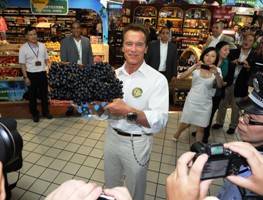
Governor Arnold Schwarzenegger’s recent trade trip to China for the California Grown program highlighted the importance of the Chinese market for California products.

In a 2009 survey, the majority of Chinese grocery shoppers preferred grapes from California over any other source, including Chinese-grown grapes.

“From the beginning, we knew China had the potential to be a great market for California grapes,” says Kathleen Nave, president of the California Table Grape Commission, Fresno. When the market first opened in late 1997, California grapes were available in just three cities in that country. “Since then, we’ve expanded access to California grapes and promotion programs into all regions of the country.”


While visiting a market in Hangzhou, China, the governor posed with a basket of California-grown grapes (pictured) showcasing the high-quality California products available to Chinese consumers.


Last year, China was the number two export market for California grapes with nearly 4.2 million 19-pound boxes of grapes shipped to that country. Canada was the number one export market.

 The California Table Grape Commission was created by the California legislature in 1967 to increase worldwide demand for fresh California grapes through a variety of research and promotional programs. More at grapesfromcalifornia.com.

 http://californiafarmer.com/story.aspx/california/grape/demand/grows/in/china/9/42474

Bull Market on Wine

This recent Wall Street journal article outlines in a very simple manner the positives for wine invesment and how best to invest.  I do agree with some of its tone, but not all.  The article only really mentions ths First Growths for investment.  This is fine,  but there are many more wines worth investing in besides the First Growths of Bordeaux especially since they have become extremely expensive in the recent heralded vintages, 2000, 2005, 2009.  I feel that other less acclaimed vintages are worth looking at as they haven’t appreciated as much.  2003, 2006 and especially 2008 trade much cheaper.  You will have to have more patience with the less popular vintages, but they will increase.  Also the second wines of the First Growths are starting to trade up in value, as well as some of the “Super Seconds” of Bordeaux, with names like Chateau Cos D’Estournel, Montrose, Palmer, and one could argue Pontet Canet even though it is only a Fifth Growth.  They also fail to mention the Super Tuscan wines from Italy which also are worth buying for the long term, with names like Sassicaia, Ornellaia, Tignanello,  and Massetto.   

Nonetheless, many people including myself are finally starting to realize that wine is a wise alternative investment vehicle, especially with bond yields so low, and waning equity markets.                         


  • SEPTEMBER 19, 2010
  • A Bull Market for Wine

    Top vintages have outperformed almost every other asset class over the past decade. How much longer can it last?

    By WILLIAM LYONS

    The flowering of the vines in Bordeaux took place in unsettled conditions this year. The chances are that the region’s grapes will not all ripen at the same time. This in turn will make for a tricky harvest and – in all probability – a small, weather-affected crop for the 2010 vintage. There have also been a number of storms, which can lead to high humidity and the possibility of rot. This is not good. 

    Journal Reports

    Read the complete Wealth Adviser report from The Wall Street Journal Europe. 

    Traditionally Bordeaux’s early vintage forecasts were only of interest to a handful of oenologists and wine merchants. But given the returns being made on wine investment, far more people are now interested in the weather before harvest time in the world’s largest fine wine region. 

    In the cellars of the most famous Châteaux that line the gravel mounds of the Gironde estuary in Bordeaux, the 2009 vintage has been maturing in barrel. This is undoubtedly the most hyped vintage since records began – eclipsing the famed vintages of 1961, 1982 and 2005. Even before the wine has been bottled, its value has already soared. Interest in wine investments is keeping pace. 

    Those that bought the 2009 vintage early, through the futures based en primeur system are, in certain cases, already sitting on a paper profit. Figures from Fine + Rare wine brokers show that Château Lafite Rothschild 2009 has already risen 36% from £10,000 a case when it was released on the market in June to £13,657 today. Similarly Château Latour 2009, also produced in the commune of Pauillac, has risen 20% from £10,000 a case when it was released in June to £12,000 today. 

    [WineStat] Abi Hardwick 

    Château Lafite Rothschild 2000 has climbed 611% since December 2004 – when Fine + Rare first started compiling figures on wine investments. A case that would have cost £2,560 in 2004 is now worth £18,400. 

    Château Petrus 2000 has climbed 255% from £12,000 in December 2004 to £36,627 today giving the buyer a return of £24,627 a case. It is not difficult to see why those with a spare £100,000 in the bank are increasingly being tempted to take a punt on some of the world’s finest wines. 

    Live-ex’s Fine Wine 100 Index, the London International Vintners Exchange, which tracks the price movement of the world’s 100 most sought after wines, has climbed by more than 200% since it was launched in 2001. That’s a remarkably resilient performance during a period of such economic uncertainty. 

    Wine brokers put this down to the fact that fine wine is a luxury product that people aspire to own. Crucially it is limited in supply: Château Lafite Rothschild produces around 480,000 bottles a year; Château Latour, only around 350,000 bottles. And unlike other luxury items, production cannot be increased because the vineyard areas are more or less fixed. As demand increases supply diminishes because as many, if not more, people want to drink the best vintages as invest in them. 

    Greater Demand

    Mark Bedini, chief executive and founder of wine brokerage Fine + Rare Wines Ltd, says: “The plus side of wine investment is that as time goes by it gets scarcer as people drink it. The likelihood is that over time – as the wines get older, rarer and in greater demand – prices will inexorably increase.” 


    iStockphoto/Abi Hardwick

    WineBull

    WineBull

    In recent years, these increases have been turbocharged by interest from the Far East most notably mainland China and since 2008, Hong Kong. In that year the Hong Kong authorities abolished all import duty and taxes on wine. This fuelled a huge boom in the Asian market. Wine merchants Berry Brothers & Rudd, who also run a brokerage department, are just one of a number of European merchants and auction houses that have set up offices in Hong Kong. 

    Adam Bilbey, direct sales manager with Berry Bros & Rudd in Hong Kong says the wine industry has only just started to scratch the surface of the potential Asian market. 

    He says: “There has been a huge increase in interest, which started with Hong Kong but has now spread to mainland China. It is driven by the über-wealthy looking for luxury brands.” Many are buying wine to drink or give as gifts, according to Mr. Bilbey. 

    So given that there are significant returns to be made, how does one go about creating a wine portfolio? Firstly, it is important to choose your Châteaux carefully. Only a very small number of wines have investment potential. 

    Experts say the highest returns can be found among the very top wines in Bordeaux’s Medoc region, classified as First Growths: Châteaux Lafite Rothschild, Latour, Margaux and Mouton Rothschild and Haut Brion, although the latter hasn’t performed as well as the others. A handful of wines from the other side of the river in Bordeaux – most notably Château Petrus, Le Pin, Cheval Blanc and Ausone – can be added to this list. 

    Outside of Bordeaux, a few of the very best wines in Burgundy such as Domaine de la Romanée-Conti and Lalou Bize Leroy can offer significant returns. There are also a handful of Rhone wines and Champagne houses. 

    Mr. Bedini says: “If you are looking at it purely for investment then my recommendation would always be to look very exclusively at a small number of Bordeaux wines from 2009, 2005, 2000 and 1996 vintages. 

    “The great thing about Bordeaux is that they are very liquid so if anyone wants to sell their wines they are going to trade out pretty quickly. The four I would recommend are: Châteaux Margaux, Mouton, Lafite, Latour. Châteaux Petrus is more valuable but harder to sell quickly.” 

    [WineParker] ReutersRobert Parker’s 100 point rating system moves markets and menus 

    By far the best way for private investors to purchase Bordeaux is through the summer en primeur campaign when the wines are offered a year ahead of bottling and shipment, having been tasted from the barrel. The upside to this is that you can secure allocation and favorable opening prices. The down side is that the prices can fall if the wines fail to live up to the initial hype. 

    The price of a wine is largely determined by its quality. The key marker of this is the view of American wine critic, Robert Parker, who scores all wines on a 100-point scale. Mr Parker’s scores are published on his website, erobertparker.com. The Wine Spectator, which also scores wines out of 100, and the opinions of British wine critic Jancis Robinson are also worth checking. There are a number of brokerages and merchants who sell wine en primeur and store it, for a fee, under bond so that you don’t have to pay duty or VAT. 

    Wine Investment Funds

    The other investment route is through a wine investment fund. These tend to charge a 5% subscription fee, annual management fees of 1.5% or 2.5% and an average exit fee of around 20% of the upside. The Vintage Wine Fund, Wine Asset Managers and The Wine Investment Fund have all been authorized by the U.K. Financial Services Authority. 

    It is important to note that in the past fraudulent companies have preyed on wine investors and it is still a largely unregulated market. 

    And, although wine has fared better than most investments, there is always a risk that the price will fall. A recent example would be Château Figeac 2009 and the sweet wine Château d’Yquem 2009, neither of which have appreciated in value. The 2005 vintage of Château Figeac has fallen 2% since it was released on the market in 2006. 

    [WineLineChart] 

    Jack Hibberd, director of Liv-ex, said: “The market rose 38.3% over the past year to the end of July. It has been through a strong bull market on the back of the 2009 Bordeaux campaign. But the value of some wines bought at the end of the en primeur campaign has actually gone down. It hasn’t been proven whether buying large quantities of 2009 has been the best strategy. It is certainly not clear cut.” 

    It is a view echoed by drinks analyst John Wakely, of specialist corporate finance firm The Angel’s Share. He said: “As long as demand is there it keeps increasing. But there are some telltale signs that as an investor would lead me to be selling high-end wines right now. When you get into a London taxi and the cab driver starts talking about wine investment, that’s the time you short the hell out of it.” 

    Despite this Simon Staples, sales director at Berry Bros & Rudd, says he has never been as bullish as he is now. “Fine wine has a minimum of 10 years more to go in terms of value. Asia is already exciting but we haven’t even begun to see the start of it yet.” 

    Mr. Lyons is the wine correspondent for The Wall Street Journal Europe and is shortlisted for the 2010 Louis Roederer International Wine Columnist of the year. He can be reached at william.lyons@wsj.com

    Link to article here: http://online.wsj.com/article/SB10001424052748703959704575453172661252804.html?mod=googlenews_wsj

    Champagne for Investment?

    I recently added some 2002 Dom P and 1999 Taittinger Comte de Comte to my portfolio for the long term, and found this recent Liv-ex post (“Focus on Fizz”) on the bubbly extremely interesting.  Apparently Champagne values have increased but no where near the levels of Bordeaux which probably makes it a good buy from an investment point of view.  Dom Perignon 2002 has serious potential to appreciate as it is one of the worlds most sought after wines, and one of its highest rated vintages in history.  They do make a lot of it, but it does disappear over time as it so hugely popular in hotels, restaurants, bars, etc. A wine consultant of mine at Sokolin wines in NY also recently told me something intriguing:  Dom Perignon is always the first wine to be bought by credit card fraudsters, because of its prestigous status.  Hmmm, I guess this makes sense though, because even the crooks know what the best stuff is.  The 2002 Vintage is highly rated and could be legendary…..forget stocks. buy Champagne  

    21 September 2010 

    Focus on fizz
    This month, the start of the 2010 harvest in Champagne coincided with reports that global shipments of fizz increased by nearly 40% in the first six months of the year. And though champagne trade on Liv-ex remains well below last year’s average, prices appear to be edging up. The Liv-ex Champagne 25 Index – which tracks 25 top vintage wines from Dom Perignon (9 vintages), Louis Roederer Cristal (8) and Krug (8) – rose 5.58% in August to a new high of 262.57. The index is currently up 3.23% year-to-date and 4.63% year-on-year. If we take a closer look at each brand individually, it appears that Louis Roederer Cristal has put in the strongest price performance since August last year, having risen in value by 8.84%, followed by Dom Perignon at 4.05%. Krug vintages have seen very little movement, gaining just 0.03% year-on-year.  The chart below shows the year-on-year price performance of the three brands that make up the Liv-ex Champagne 25 Index. With Christmas and New Year just around the corner, will champagne prices continue to push upwards?   

     Champagne performance by brand 


    Wines from Michigan?

    Clearly when people think of wines from America, California is the first state to be mentioned, followed by Oregon, Washington and probably New York in fourth. This article below by Ellin McCoy begs to differ as apparently Michigan is making some serious progress.  Plus the wines look like serious value for money. Check it out:


    Just Because I’m in a Madhouse, It’s Not Crazy to Drink Local

    By Elin McCoy – // Sep 13, 2010


    Sipping pinot blanc in a former mental asylum, I’m testing my decision to drink local wine during my annual summer stay by Lake Michigan.

    The whites at Left Foot Charley winery, housed in what was once the laundry of the state loony bin in Traverse City, are so crisp and savory they convince me my palate won’t suffer if, while here, I’m a “locapour”.

    The word means someone who’s committed to drinking the vino of the region — say, within a 100-mile radius to a half-day drive of wherever they are. Coined by the Globe & Mail’s Beppi Crosariol a couple of years ago, it’s become the liquid counterpart to “locavore,” the buzzword of the growing “eat local” food movement.

    When I travel, I’m usually a happy locapour. On Santorini this summer, I, and everyone around me, knocked back the Greek island’s edgy white assyrtikos every night with grilled fish. I did not feel Burgundy-deprived. Of course, I only stayed for a week.

    Drinking local in most parts of America (read: outside California, Oregon, and Washington State), though, used to be very tough. Not so long ago there weren’t that many wineries in states like Texas or Colorado or Michigan and quality was hit or miss. I still recall my reaction to a tasting of 100 Michigan wines here 20 years ago — I was only willing to swallow three.

    But wine is now produced in all 50 states, even Alaska, and ten have more than 100 wineries, inspiring website drinklocalwine.com. A lot of their wines are pretty good and, as with the best bottles in Michigan, many cost under $25. Reasons, in my book, to become a locapour.

    Asylum Lawn

    At Left Foot Charley, owner-winemaker Bryan Ulbrich fills me in on northern Michigan’s wine scene before I head to the tents on the asylum’s lawn for the annual Traverse City Wine and Art Festival, which features the 22 local wineries.

    He points out a relief map on a winery wall that shows two green fingers of land — the Leelanau and Old Mission peninsulas — jutting into a blue bay of Lake Michigan. Just a few miles from where we’re standing, these narrow promontories are home to the area’s vineyards. Yellow pegs on 18 mile-long, 3 mile-wide Old Mission mark where Ulbrich sources his riesling, pinot blanc, pinot grigio, and gewurztraminer.

    “We can make world-class examples of these whites,” he says, citing the sandy soil and the “lake effect” that moderates the harsh winters. Yet 2009 was a challenge, with heaps of snow and temperatures of minus 15 Fahrenheit (minus 26 Celsius).“We’re like old school Europe,” he admits, “you taste real differences in vintages here.”

    Tart Lychees

    At his tasting bar, crowded with weekend sippers, Ulbrich starts me off with a zingy 2009 Dry Riesling ($20) with the slatey taste of wines from Germany’s Saar region. The exotic 2009 Gewurztraminer tastes of tart lychees ($20). A very spicy 2009 Rose ($15) made from cabernet franc, millot (a hybrid grape), and lemberger, known in Austria as Blaufrankisch, is gulpably delicious.

    Ulbrich produces no reds, though he consults with local wineries that do.

    “I’m very harsh about the idea of reds here. I say, what’s the point? My wife says to shut up about that,” he chuckles.

    The mental hospital closed in 1989 and a few years ago a developer began transforming the site’s several dozen yellow brick buildings into The Village at Grand Traverse Commons. In 2007, Ulbrich, along with bakeries, a coffee company and restaurants, moved in.

    Blues Singer

    I make my way through the Mercato, a series of food and clothing shops in spaces that once housed patients, to the festival’s big tents on the vast lawn. A blues singer tests a microphone; people rush for the food; and I show my plastic wristband at the entry to the wine tent.

    Ulbrich is right about the quality of the rieslings here — many are light, German in style, with fine flavors but often not much fragrance. Chateau Grand Traverse, the first to plant vines on Old Mission in the ‘70s, pours a fruity, steely-dry 2008 Dry Riesling ($12.50).

    I’m pleasantly surprised by the reds. A fragrant, berry- flavored 2005 Gill’s Pier Cabernet Franc/Merlot shows the region’s potential. Several cabernet francs remind me of Loire valley Chinons, especially the softly attractive 2008 Arcturos, Black Star Farms’ top label ($27.50). Shady Lane’s berry and plum-flavored 2008 “Blue Franc” ($23), a proprietary name for lemberger, has notes of cedar and a silky texture.

    Plenty of hip experimentation is going on. Circa Winery co- owner David Bell, in owl-style glasses, long straight hair, black shirt and pants, admits, “We don’t really like riesling.” Their 2008 Requisite blends cabernet franc and pinot grigio.

    While I’m certainly not giving up drinking international, there are pleasures to discover in becoming a locapour, especially during early fall. Just about every wine region will be holding a weekend tasting festival, like the one in Long Island wine country on Sept. 24 and 25. As an East Coast locapour, I’m putting it on my calendar.

    Traverse City Wine and Art Festival

    Wines are displayed at the Traverse City Wine and Art Festival in Traverse City, Michigan. Due to state liquor regulations, volunteers must pour the wine, and the vintners can only explain and answer questions. Photographer: Elin McCoy/Bloomberg

    Bryan Ulbrich

    Bryan Ulbrich, owner-winemaker at Left Foot Charley Winery, charts his excellent white wines at the Traverse City Wine and Art Festival at the Village at Grand Traverse Commons, formerly a state mental hospital, in Traverse City, Michigan. Ulbrich’s winery is in what was once the hospital’s laundry. Photographer: Elin McCoy/Bloomberg

    Left Foot Charley

    A rose and dry riesling are among the wines being poured at the tasting bar of Left Foot Charley Winery in Traverse City, Michigan. The winery, in the former laundry of a mental asylum, sources all its grapes from nearby 18-mile long, 3-mile wide Old Mission Peninsula.

    (Elin McCoy writes on wine and spirits for Muse, the arts and leisure section of Bloomberg News. The opinions expressed are her own.)

    Link to full article here: http://www.bloomberg.com/news/2010-09-13/just-because-i-m-in-a-madhouse-it-s-not-crazy-to-drink-local-elin-mccoy.html



    Batali’s Packed Eataly Has $193 Porchetta

    When I started this blog, I originally was going to focus solely on wine,  but how could I talk about wine and not mention food?  My lovely wife Lara is from the northwestern coast of Italy from a town called Genoa.  And yes, ham and salami are very popular there, but what most people don’t know is that Genoa is most famous for its Focaccia bread.   She has now perfected making this, and recipes will follow in due course.  Below is a bloomberg review on the new Italian supermarket in Manhattan called silly enough, EATALY.  This sounds like a fun place.  Maybe one day my wife could open a shop there?……hmmm…..I miss New York…what a fun city.


    Batali’s Packed Eataly Has $193 Porchetta, Ridiculous Waits: Ryan Sutton

    By Ryan Sutton – // Sep 15, 2010 5:01 AM GMT+0100


    The line wound down Fifth Avenue from 23rd Street through Manhattan’s Flatiron district as security guards flanked multiple entrances to the former International Toy Center.

    The hubbub wasn’t for a nightclub; it was for the first American outpost of Eataly, an Italian supermarket with a marquee’s worth of food-world royalty attached: mega-chef Mario Batali, his business partner Joe Bastianich, chef Lidia Bastianich and Oscar Farinetti, who also backs the chain in cities including Turin, Milan, Bologna and Tokyo.

    Forget about the dopey name. Eataly is full of wonders. Is there greater culinary transparency anywhere? The profusion of reading material on the walls tells us that the Iowa pigs were raised on clover, Michigan lamb reared on hay, Montana beef allowed to roam in pastures and Pennsylvania calves kept outside of cages. Why get anyone else’s rotisserie chicken when you know this $9 bird is moist, well-seasoned and antibiotic free?

    The longer lines at Eataly are not for the take-away but for the restaurants. I waited 10 minutes just to speak with a host at a pizzeria that refused to serve me pizza — they were booked for the night.

    No Escape

    So I went to the fishery, where I was seated after 45 minutes. Ever go to a restaurant and think you could make it faster at home? Eataly provides the raw ingredients to follow through on that threat. “We eat what we sell; we sell what we eat,” is the mantra. I watched a live langoustine make a last ditch freedom attempt. Sorry bro.

    There are 14 places to dine at Eataly, four of them actual restaurants, five if you count the piazza where you eat nutty, salty prosciutto di Parma standing up at tables so high no shorties need apply.

    Take your glass of Prosecco or a super-strong Negroni and browse the aisles with caution. A 10-pound porchetta roast costs $193. Smaller portions were sold out by 7 p.m.

    At Eataly, ambience takes a back seat to cuisine. Men in double-breasted suits quaff rose near the bottled chocolate milk station and I chewed through a $75 beef tasting menu while overlooking the olive oil department.

    That six-course meal took place at Manzo, which I’ll review later this fall after contemplating how I feel about paying $133 in a venue lacking a clean, nearby restroom.

    Creamy Mozzarella

    For now, I can vouch for the take-home stracciatella di burrata (extra creamy mozzarella) and a $5 basket of heirloom cherry tomatoes. The produce section’s maitake mushrooms, at $7 a pound, were cheaper and prettier than any I’ve purchased at Whole Foods.

    The people behind the meat counter were skinny while the vegetable butcher (his real title) was bald and fat. Go figure. Le Verdure, the mostly-vegan spot, serves real veggies cooked in olive oil and sea salt, as opposed to the silly soy-protein fake meat espoused by culinary crazies.

    Try killer tomato soup, vegetable fritto misto ($21) and pesto lasagna ($16 — with dairy) whose firm texture bested a version I had at Del Posto.

    I wish the restaurants would mix things up a little more. I couldn’t get pasta at Il Pesce, the fish spot, which dished out a pallid, underseasoned seafood soup ($12). Stick with the trio of crudo ($19) from Esca’s David Pasternack. Halibut belly with tangerine oil and pink peppercorns was a solid argument against overfished bluefin tuna. Finish with roasted orata ($24) which you debone yourself, after which the waiter congratulates you on your expert filet skills.

    Seafood Pizza

    They do serve fish at the pizza place, which I finally breached after an hour wait. Was it worth it? Not for undersalted fusilli in a paltry beef ragu. But definitely for what could be the city’s best seafood pizza, studded with a sufficiently briny (but not assertively salty) mix of creamy clams and squid over chewy, well-seasoned dough.

    Skip the “traditional specialty guaranteed” $18 pie with mozzarella di bufala — it’s indistinguishable from the $13 non- buffalo version. Like any great pizza, the olive oil just barely cuts the tomatoes’ acidity; the cheese is warm, not blistered; the over-charred crust just barely droops in the middle. A second visit (to the newly opened takeout stand) proffered a crust with a lighter, more bearable wood-oven tang.

    Yeasty Squares

    Just crave a slice? No problem. A focaccia hawker sells yeasty squares of dough topped with tart tomatoes and musty pancetta. If only the casual spot here served dessert; when dinner’s over, most of the (excellent) gelato is sold out.

    Eataly is at 200 Fifth Avenue at 23rd St. Information: +1- 646-398-5100; http://www.newyork.eataly.it

    (Ryan Sutton writes about New York City restaurants for Muse, the arts and entertainment section of Bloomberg News. The opinions expressed are his own.)

    LINK TO FULL ARTICLE:   http://www.bloomberg.com/news/2010-09-15/batali-s-packed-eataly-has-193-porchetta-ridiculous-waits-ryan-sutton.html

    2006 Domaine La Milliere Cotes du Rhone Villages Vieilles Vignes

    From another stalwart Chateauneuf du Pape producer, comes this elegant, silky Cotes du Rhone from Domaine La Milliere which is serious value for money. Made mostly of Grenache from 100-year-old vines?! Are you kidding me….Awesome stuff.  Ruby red color, with hints of apricot and spice.  The Chateauneuf must be amazing.  I will have to try some at some point, but I’m sure it retails for much more.  You can find this Cotes du Rhone at Uncorked Wines in the UK for about 10£ a bottle if you buy a case.  Available at Zachys in NY on sale now for $15.00 a bottle.  An absolute steal….If you like big, smooth red wines, you will not be disappointed.  This will obviously pair well with rich meaty dishes, but a pleasure to drink on its own.


    Robert Parker give is 87 pts, but I think it deserves higher, my rating 90pts.

    Wine Advocate # 178
    Aug 2008
    Robert Parker 87 Drink: 2008 – 2012 $18 (18)
    The 2006 Cotes du Rhone is slightly more austere and lean, but still very good, almost tasting like a premier cru from Burgundy’s Cote de Beaune. Both wines should be drunk in the next 3-4 years.This is an estate to take notice of, as recent evaluations in this guide have certainly made abundantly clear. This is another great example of young emerging newcomers, in this case Aime and Michel Arnaud, doing all the right things to turn out some impressive wines. This fine estate offers two very tasty, inexpensive Cotes du Rhones.  


    link to website here: http://la-milliere.fr/en/cotes-du-rhone-rouge.html

    Value Wines, Wine Spectator’s Consumer Opinions

    Below is a recent Wine Spectator article on which details an intriguing, albeit US biased survey about consumers’ views on value wines.   What I found interesting was that according to the poll, the most reliable source of value chosen was South America, with 43 percent choosing Chile,  followed closely by Argentina at 40%.  Also 30% believe 15$ and under holds the best overall value, whil 29% favor $15-20$ range.  


    Value Wines: Consumers’ Opinions, Uncorked


    California’s Central Coast, Bordeaux and Spain top our readers’ wish list for values, plus other surprising results from our survey

    Tim Fish
    Posted: September 13, 2010

    Wine lovers continue to buy cautiously and are interested in good value more than ever, according to the results of a recent survey conducted on WineSpectator.com.

    “So many great values exist because of an oversupply of wine, that I am spending the same as last year but buying a lot more high quality wine for the dollar,” wrote a male consumer over 50 from the western United States.

    Spending patterns have stabilized a bit—and even geared up somewhat—since last year’s dramatic decline in the wake of the 2008 financial panic and ensuing recession. About 40 percent of respondents said they are spending about the same as a year ago. (About 29 percent reported the same thing in a similar survey in 2009.)

    Thirty-eight percent said they were now spending less on wine compared with a year ago (24 percent are spending a little less; 14 percent are spending a lot less).

    By contrast, in the 2009 survey, 61 percent of respondents said they were spending less than they did the previous year. And while last year’s survey found only 10 percent of respondents spending more on wine, that number more than doubled this year, with 22 percent of respondents reporting increased spending.

    Younger wine drinkers are even more enthusiastic. About 48 percent report they are spending more money than a year ago. That’s a good sign for those watching the drinking habits of this new generation of wine lovers. “I’m still learning about wine, and the more I learn, the more I spend,” wrote a man in his 20s.

    Since everyone appreciates advice on a good bargain, we asked readers from which regions they would most like to have value recommendations (respondents could choose up to three regions.) Leading the pack in the New World, with 39 percent of the vote, was California’s Central Coast, which includes wines from Monterey, San Luis Obispo and Santa Barbara counties. In looking for advice on Old World values, there was a three-way tie among Spain, Bordeaux and Tuscany, each with a preference level of 41 percent.

    To help you uncover some of the well-priced treasures these regions have to offer, the Oct. 15 issue of Wine Spectator features a selection of our favorite bottlings from recent tastings, with a focus on the Central Coast, Bordeaux and Spain. (Look to our Oct. 31 issue for the best values on the market from Tuscany.)

    In searching for your next values discovery, many of you said you look to the New World. When asked to identify the state or country viewed as the most reliable source of values, South America came on especially strong, with 43 percent of respondents choosing Chile, followed in short order by neighboring Argentina, at 40 percent. (Respondents were asked to identify their top three destinations for reliable value.)

    “South America is awesome in the value category,” wrote a 30-something male from the Midwest. Other New World regions identified included California, chosen by 36 percent; Australia, preferred by 34 percent; and Washington, at 29 percent. Among Old World regions, Spain led the way with 36 percent, while France and Italy tied at 22 percent each.

    While values are in demand, that doesn’t always mean the cheaper the better. Only 2 percent of respondents said they’re looking for wines priced less than $8. About 30 percent said they believe the $15-and-under category holds the best values overall, while slightly more than 29 percent favored the $15 to $20 range. “Value varies with the varietal,” wrote a Midwestern male consumer over 50. “To me, a great $40 Cabernet or Bordeaux is a value, as is a great $25 Pinot Noir and a great $20 Chardonnay.”

    The fact that high quality, low-priced wines can be made at all—given the costs involved from vineyard to table—is still a source of wonder for some. “I am always amazed that so many values come from faraway places. How much profit can be generated after shipping and distributor costs?” wrote one respondent.

    There was widespread agreement among respondents about how they most frequently consume value wines, with 72 percent saying they choose them to accompany casual, weeknight meals. Sharing values at parties was the second most popular response, with 54 percent. (The survey allowed readers to choose up to three answers among six possible values occasions.)

    Drinking wine as an aperitif or as a stand-alone pleasure was reported by 52 percent of respondents, while 32 percent consume wine for purposes of education or exploration. In contrast, only 15 percent said they purchased value wines for (short-term) aging. One man over 50 from the Northeast, who often serves value wines for educational and exploratory reasons, wrote, “There is a certain satisfaction in serving a delicious $10 wine.”

    No matter what the price, red wine was the drink of choice among respondents, with 82 percent saying that at least half of the wine they consume is red. Only 13 percent said that for white. “I don’t drink whites,” was a common refrain echoed by a female consumer over 50 who lives in the West. For every 10 bottles consumed, 55 percent of respondents would include a single bottle of sparkling wine, but 28 percent would include none at all. Rosé fared the worst, with 44 percent not drinking a single bottle out of 10, and 42 percent drinking only one bottle of pink.

    As for which wines you consume most often, bottlings from North America dominate. Of every 10 bottles consumed, 62 percent of respondents said that four or more are from California, the Pacific Northwest and other regions in the United States and Canada. Sixty-eight percent said they drink one or two wines from Australia and New Zealand out of every 10 bottles; 69 percent said the same for South America and 45 percent reported that consumption level for Europe.

    Among female survey-takers, the numbers were a bit different. Just more than half said that five or more of every 10 bottles consumed came from North America. About 46 percent said one or two bottles were from Europe, while 43 percent choose a single wine from South America and 37 percent a single wine from Australia and New Zealand. Only a third of women said they are buying less wine than a year ago, while two-thirds were buying the same amount or more. In addition, while red was still the color of choice, almost 60 percent said that one of every 10 bottles purchased was a sparkling wine, and 40 percent said that one in 10 was a bottle of rosé.

    Finding high quality values that offer plenty of room for exploration in terms of flavor, type and style can be challenging, given the vagaries of production and distribution. But consult Wine Spectator’s Oct. 15, 2010, value charts or the Value Wines section of WineSpectator.com, where we include only wines that are made in good quantities, adhere to quality and price criteria and were tasted by Wine Spectator editors over the past six months, so many should be available at your local wineshop or grocery.

    If you are interested in finding the best values from California, Spain, Bordeaux and beyond, here’s your chance. You made the call, and these wines deliver the goods.

    View charts of our Value Wines Survey results (in PDF Format)

    link to article: http://www.winespectator.com/webfeature/show/id/43572


    2007 Cap de Faugeres, Cotes de Castillon

    This smooth, easy drinking bordeaux blend from Chateau Faugeres’ stable is a beauty.  It bounces of the glass in more of a new world style.  Full bodied,  rich blueberries and spice on the palate. This has nice length, and velvety tannins.  It will be drinking well for at least another 5 years, but is extremely hard to resist now.   Chateau Faugeres makes 4 wines with Peby Faugeres, Chateau Faugeres, and Haut Faugeres all falling in the St. Emilion Grand Cru Classe.   These 3 wines retail for much more due to their St. Emilion classification and slightly different terroir.  Cap de Faugeres is made in the same way as the other wines from Faugeres from vineyards which are adjacent but just over the border into Cotes de Castillon (the St. Emilion/Cotes de Castillon border bisects the property).   This wine is an absolute steal at 11£ per bottle.   Buy it by the case load.  The infamous Robert Parker also gives it a thumbs up:


    2007 Cap de Faugeres, A Bordeaux Blend Dry Red Table wine

    Wine Advocate # 188
    Apr 2010
    Robert Parker 89 Drink: 2010 – 2017 $11-$16
    Proprietor Silvio Denz seems to have captured some serious magic in this blend of 85% Merlot and the rest Cabernet Franc and Cabernet Sauvignon. A sleeper of the vintage, it offers a dark ruby/purple color, abundant black currant, black cherry, spice, and charcoal aromas, a big, dense, rich style, and 5-7 years of drinkability. Bravo!


    Available at Daft Investments,  www.daftinvestments.com.  In London, contact Donald Howes, the main UK importer of their wines (O) +44 (0) 207 252 5249   (M) +44 (0) 7931 973 287     Here is the price list:

     UK Price List 2010 05 18

    Available in the U.S. at Zachys and Sherry Lehmann in New York  for 16-20$ a btl.


    Link to Chateau Faugeres website: http://www.chateau-faugeres.com/index_uk.html


    My rating: 90 pts

    English Wine Beats Champagne?

    I have never tried any English wine even though I live in London.  I have heard good things though, and apparently this particuliar  English “sparkling wine” is serious indeed.  I need to do some more research on this one….my review coming in the future, stay tuned…..See telegraph article below:


    English wine beats champagne to win Decanter

    trophy

    A little known English wine has beaten world-famous champagne houses to “remarkably” win one of the most important awards in the wine industry, being named as the best sparkling wine in the world.

    Ridgeview, Grosvenor Blanc de Blancs, 2006, made from grapes grown in Sussex, picked up the Decanter international trophy for sparkling wine over £10 last night.

    It beat more than 700 Italian prossecos, Californian sparkling wines, Australian fizzes as well as illustrious champagnes from Charles Heidseck, Taittinger, Moët & Chandon that were submitted.

    The wine, which costs £21.95, was deemed higher quality than champagnes costing nearly three times as much.

    English wine has been winning an ever greater number of awards and plaudits in recent years, but this is the first time that any vintage from this country has won an Decanter International trophy.

    Christelle Guibert, the tastings director at Decanter, said: “What a result. As if further proof was ever needed, this unequivocally rubber-stamps England’s membership to that exclusive club of truly world class, sparkling wine producers. Up against a clutch of Champagne’s finest, Ridgeview has produced a stupendous wine that defeated them all. It’s a truly remarkable win.”

    Though Ridgeview is relatively unknown outside of the wine world, it has been steadily garnering praise. Last year it beat its better known English rivals such as Nyetimber, Chapel Down and Balfour to be crowned Best Wine in England in the English & Welsh Wine of the Year Awards. Waitrose and Oddbins, the high-street wine merchant, has stocked it for a number of years.

    The Decanter judges described the wine as, “lemony, floral nose which is elegant, discreet, biscuity and youthful. Refined and refreshing palate, with lemon rind, vivacious acidity, minerality, precision of flavour and plenty of élan. Stunning.”

    Ridgeview Estate is a family business with a 16-acre vineyard on the South Downs. Set up husband and wife Michael and Christine Roberts in 1995, it is now a fully-fledged family business with their daughter Tamara, their son Simon and his wife Mardi all working for the winery.

    English wine beats champagne to win Decanter trophy 

    Set up husband and wife Michael and Christine Roberts in 1995, Ridgeview Estate is now a fully-fledged family business
     
    English wine beats champagne to win Decanter trophy
    Ridgeview, Grosvenor Blanc de Blancs, 2006 costs £21.95

    link to article here: http://www.telegraph.co.uk/foodanddrink/wine/7974936/English-wine-beats-champagne-to-win-Decanter-trophy.html

    Related Articles

    Clos de los Siete article

    Here is a recent bloomberg article on one of my favorite value Argentinian reds, Clos de Los Siete.  It is widely available and always a joy to taste.  It is muscular malbec with bordeaux in mind.  If you are a light beaujolais fan, this is not for you…This wine is strong like bull, not weak like lamb…my review to follow in due course…..


    ‘Satan’ of Grape Consulting Blends Own High-Alcohol

     Red Wine

    By John Mariani – // Aug 31, 2010 5:01 AM GMT+0100

    Clos de los Siete wine. The $19 red wine, principally malbec, is from Mendoza Valley in Argentina, made by Michel Rolland and partners.

    Bordeaux vigneron Michel Rolland, consultant for more than 100 wineries in a dozen countries, is blamed by some for fostering the fashion for high-alcohol cult wines like those from California’s Harlan Estate and Staglin Family. Yet a recent tasting of Rolland’s seventh vintage of the Argentine wine Clos de los Siete shows he is able to make a 21st century-style red at the top of its class. And with the 2008 vintage, he does it for only $19 a bottle.

    Clos de los Siete is a blend of 56 percent malbec, 21 percent merlot, 11 percent syrah, 10 percent cabernet sauvignon and 2 percent petit verdot. It’s made in the Uco Valley south of Mendoza, Argentina’s top wine region, where malbec is the principal fine-wine grape.

    Plenty of sun, high humidity and low rainfall coupled with sandy soil and clay provide ideal conditions for such varietals, and they come together in Clos de los Siete’s soft and velvety texture of the merlot, intense fruit of the syrah, mild tannins from the cabernet, and ballast and spice of the late-ripening petit verdot. The blend may change in any vintage and the wines are neither fined nor filtered — processes used to remove solid residues.

    At 14.5 percent alcohol, Clos de los Siete might bolster the characterization of Rolland as an advocate of reds whose deliberately overripe fruit, high alcohol, and long aging in oak produce “fruit bombs” that win medals in competition. Many critics, myself included, decry such wines as often being out of balance, headache-inducing and closer to Port than red wine.

    ‘Satan or Savior’

    A New York Times article on Rolland was entitled “Satan or Savior: Setting the Grape Standard.” In the 2004 documentary film “Mondovino,” Rolland is shown advising clients to use a technique called micro-oxygenation that can help tame tannins and soften wines.

    “That movie is all crap!” Rolland bellowed in a phone interview. “In some European wineries micro-oxygenation is helpful, but you don’t need it in New World wines because there is so much sun to build up the sugars.”

    Rolland has six formidable partners in Argentina, including Rhone Valley vigneron Catherine Pere-Vigne and Benjamin de Rothschild, owner and chief executive officer of LCF Rothschild Group. With such resources he was able to switch traditional Argentine “parral” trellising and pruning methods to traditional systems used in Bordeaux. Drip irrigation keeps the vines “stressed,” to allow the bare minimum of water. Grapes are all handpicked, and the wines aged for 11 months, 70 percent in new French oak, the rest in vat.

    U.S. Market

    Of the property’s 850 hectares, 430 are currently planted. This year the output is a hefty 50,000 cases exported to 57 countries, with 30,000 going to the U.S. Rolland thinks 100,000 cases is possible, noting “We will follow the market as to future production.”

    Rolland and his partners are aware they may have a big winner on their hands with Clos de los Siete, which means that consistency is key.

    “In many ways it is more difficult to make 50,000 cases than 10,000 because you have to take care of everything before blending,” he said. “With small production, a winemaker has the luxury of selecting from many parcels of grapes and wines; with big production, you have to get the best on a large scale right away. And with global export, the labels cannot have any variance or mistakes about what’s in the bottle.”

    Rolland chose Argentina because of its terroir, labor costs, and the open-mindedness of the New World. And he loves the sunshine, which builds up the sugars that convert into 14- plus percent alcohol.

    “When you have that much sun, you don’t need or want to manipulate the wine to have more alcohol,” he said. “It’s the natural way of the fermentation.”

    Controversy may yet swirl around Rolland and his methods, but Clos de los Siete proves that he can make a serious red wine to rival cult wines 10 times the price. At least he can with 50,000 cases. When Clos de los Siete gets to 100,000 cases, things should get interesting.

    (John Mariani writes on wine for Muse, the arts and leisure section of Bloomberg News. The opinions expressed are his own.)

    Clos de los Siete Winery

    The Clos de los Siete winery in Argentina. The state-of-the-art winery, owned by vintner Michel Rolland and international partners, annually produces 50,000 cases for export to 57 countries.

    Michel Rolland

    Michel Rolland, partner and winemaker of Clos de los Siete wines in Argentina. Terroir and sunshine make consistency key to the production of its 50,000 cases annually.

    Clos de los Siete

    Clos de los Siete wine. The $19 red wine, principally malbec, is from Mendoza Valley in Argentina, made by Michel Rolland and partners.